Solar Earthing
Earthing and bonding for rooftop and ground-mounted solar systems: frames, structures, inverters and distribution equipment.
Learn more
Bilal Solar Earthing Company designs and installs earthing for solar systems, factories, warehouses, commercial buildings and homes. Every job ends with resistance testing and recorded results, so you can see how your earthing performs.
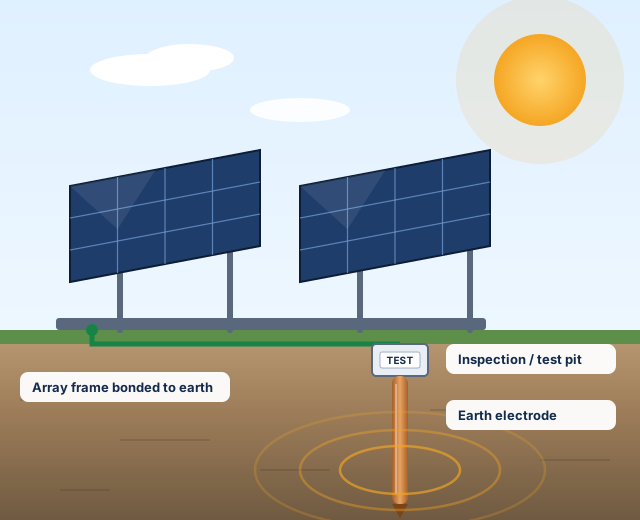
From a rooftop solar system to a production floor, we match the earthing solution to the site, then prove it with measurements.
Earthing and bonding for rooftop and ground-mounted solar systems: frames, structures, inverters and distribution equipment.
Learn moreEarthing for machinery, panels, tanks and cable routes in factories, workshops and warehouses.
Learn moreSafe earthing for homes, shops, offices and commercial buildings, including new installations and upgrades.
Learn moreProfessional installation with materials chosen for your site conditions and requirements.
Learn moreWe look at the site first, then recommend the electrodes, conductors and connections that suit it.
Learn moreEarth resistance measured with suitable test equipment and written down, with guidance on improvements.
Learn moreEarthing gives fault current a safe route to ground, helps protective devices operate, and keeps exposed metal from becoming a shock hazard. It also protects expensive equipment, from solar inverters to production machinery.
Poor earthing rarely announces itself. Connections corrode, soil dries out and layouts change, which is why we measure and record results instead of assuming everything is fine.
We visit the site and study the equipment, layout and ground conditions before recommending anything.
Electrodes, conductors and joints are selected for the application and environment, not copied from a template.
After installation we carry out resistance testing so performance is checked with instruments.
You receive recorded test results and clear improvement guidance where readings call for it.
Different sites have different earthing needs. We work with these types of facilities.
Homes and apartments with solar, inverters and backup systems.
Rooftop and ground-mounted arrays of various sizes.
Offices, shops, plazas and mixed-use buildings.
Production lines, motors, panels and process equipment.
Storage and logistics facilities with metal structures and panels.
Facilities where reliable electrical safety is critical.
Schools, colleges and campuses with many users every day.
Sensitive electronics that need stable, well-bonded earthing.
You always know what happens next, from the first visit to the final recorded results.
We visit and examine the site, equipment and existing earthing.
We confirm what the installation needs and which requirements apply.
We plan the electrode layout, conductor routes and test points.
We choose suitable materials for the site and application.
Trained technicians carry out the work using suitable PPE.
We measure earth resistance with suitable test equipment.
Readings are recorded, with advice on any improvements.
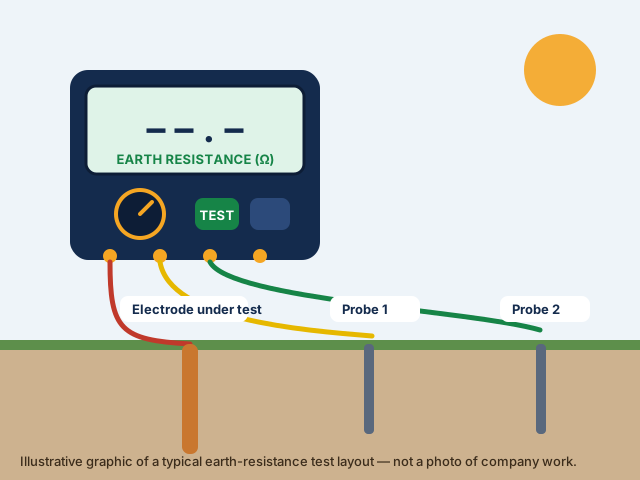
Photos of completed work will be shown here. The images below are clearly marked illustrations, not photos of our projects.
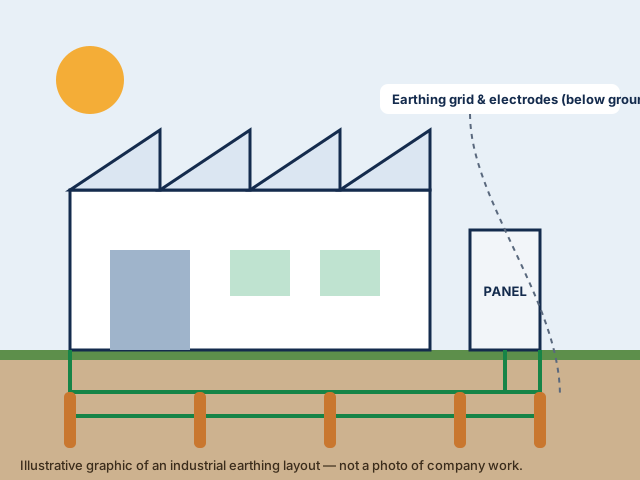
Earthing connects the metal parts of an electrical installation to the ground through a deliberate, low-resistance path. If a fault occurs, that path helps protective devices operate and stops exposed metalwork from staying at a dangerous voltage. It is one of the basic layers of electrical safety.
Solar installations include metal mounting structures, module frames, inverters and distribution equipment that normally need to be bonded and earthed. The exact arrangement depends on the system design, the site, and the standards or utility requirements that apply, which is why we begin with a site inspection.
We inspect the electrodes and connections, measure earth resistance with suitable test equipment, and record the readings so they can be compared over time.
We are based in North Nazimabad, Karachi. If your project is elsewhere, send the location and details through the quote form and we will let you know what is possible.
Tell us about your site. We will review the details and get back to you with the next steps.